Back to Nonduality & Universality
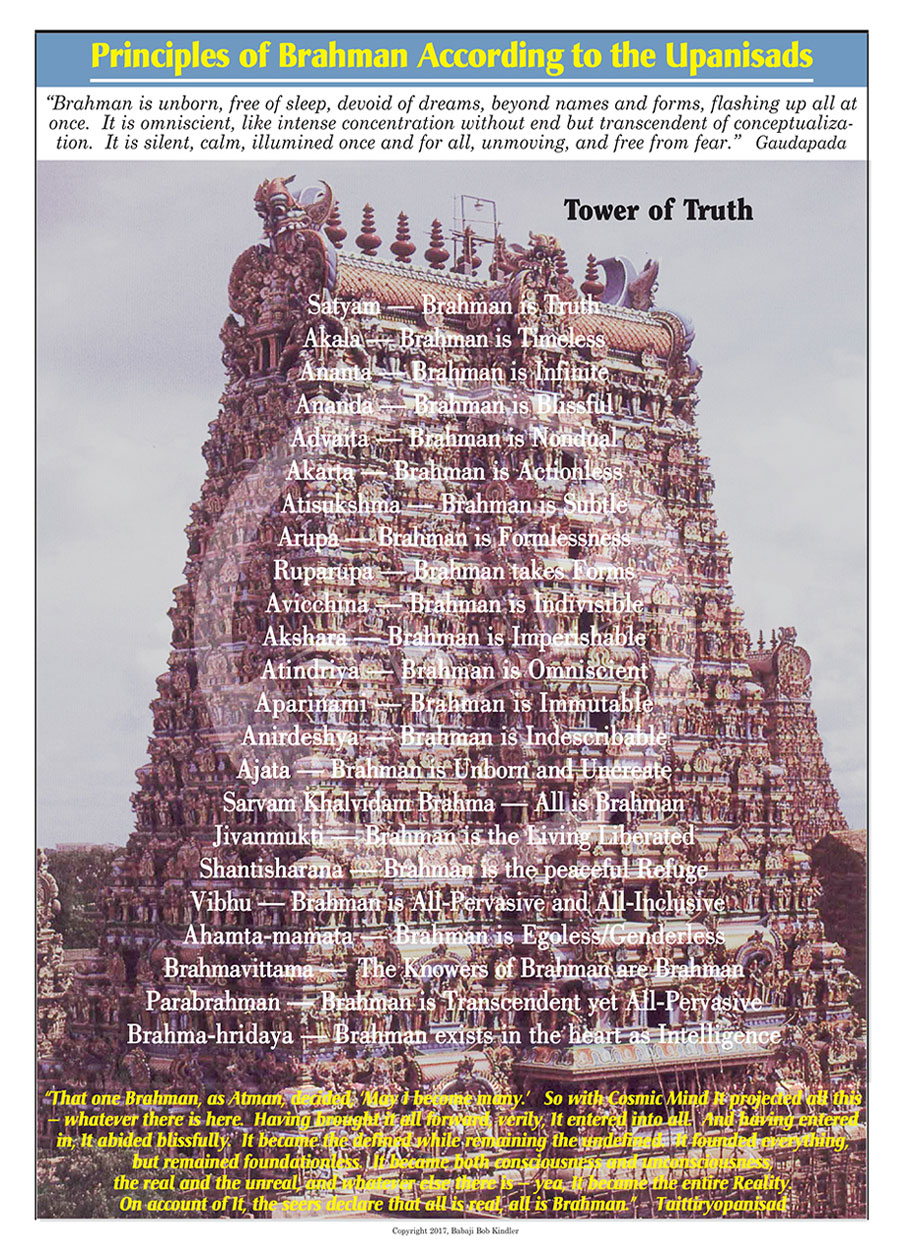
Principles of Brahman According to the Upanisads #311
$75.00
Though they are endless, like the incomparable Subject of which they speak and relate, principles pertinent to Brahman, the Nondual Reality, are legion and legend. In this dharma art wisdom chart the student and seeker can look and mentally note down the qualities of the Reality beyond qualities, thereby seeing why great souls have defined It as being “….with form, beyond form, and beyond both form and formlessness as well.”
Related products

Tathagatagarbha/Atman — The Transparency of the Self #92
In all Indian Darshanas, which are clear pathways to spiritual sight, the presence of The Presence is both key and undeniable. That It exists is Truth; that It is to be attained or reached is the Goal. And how to bring it forward out of hiding is the Way. All this is expressed in unique ways in Vedanta, Yoga, Buddhism, Tantra, and other superlative avenues to Self-Realization. The ardent seeker only has to sincerely set foot on the spiritual path and proceed forward — which is inwards — preferably under the guidance of an illumined preceptor. For, after the body passes, the soul has nowhere else to move other than inwards, into the Great Mind, or Great Self. Those exceptional beings who have become intrepid spiritual wayfarers, even when they were embodied on earth, are the true Guides who shed Light upon the Way. From the small self, to selflessness, to
the true individual self, then to The Great Self, the inward-moving pilgrim finds Divine Reality — ironically enough — waiting and abiding in his or her own self.

Vedanta, Theology, and Science #51
Whether a follower of religion, a student of philosophy, or an aspirant after Enlightenment utilizing the many inner tools and practices of spirituality, the seeker today is often confused and overwhelmed by contrasting views in the world around him/her. The three most prominent views in terms of convincing authority are science for the modern man, religion for the devotional person, and Vedanta for the free thinker and transcendentalist. Evolution, Genesis, and Nonorigination, respectively, are the main topics of these three high-minded schools of thought. When put side by side in comparison with one another, interesting juxtapositions get noticed, and doubts and confusion can be set aside for all time.

The State & Characteristics of a Jivanmukta #46
The incomparable soul, called a jivanmukta, and the state of jivanmukti itself, have long been an important feature of advanced spirituality, both sought after and lauded by the luminaries of Mother India. Like enlightened bookends presiding over a long sweep of time, the ancient and hoary seer, Lord Vasishtha, and the more recent luminary, Adishankara, both had much to say about the state of a jivanmukta – a “living liberated” soul.

Advaita Vedanta’s Pillar of Axioms #93
There is immense beauty and poetry abiding in the otherwise presumed sterility, or the presupposed emptiness, of that great principle seers and seekers call Nonduality. A step by step figuring of the process of the dissolving of human ignorance under the powerful press of advaitic reasoning is one of those beauties, and it is pure poetry, philosophically speaking. Striving souls seldom see this transformation happening to them. That marvel is reserved for the teachers, gurus, and acharyas of these adamant seekers. A clear explanation of this is to be seen on this dharmic wisdom chart, that outlines fourteen pillars of ultimate progress in the world’s finest living philosophy. To quote Vivekananda, whose image graces this revealing chart, “On planes physical, ethical, and spiritual, an ever-broadening generalization — leading up to a concept of Unity Eternal — is in the air; and this being so, all the movements of the time may be taken to represent, knowingly or unknowingly, the noblest philosophy of the unity of man ever had — the Advaita Vedanta.”