Back to Sankhya Yoga & Indian Cosmology
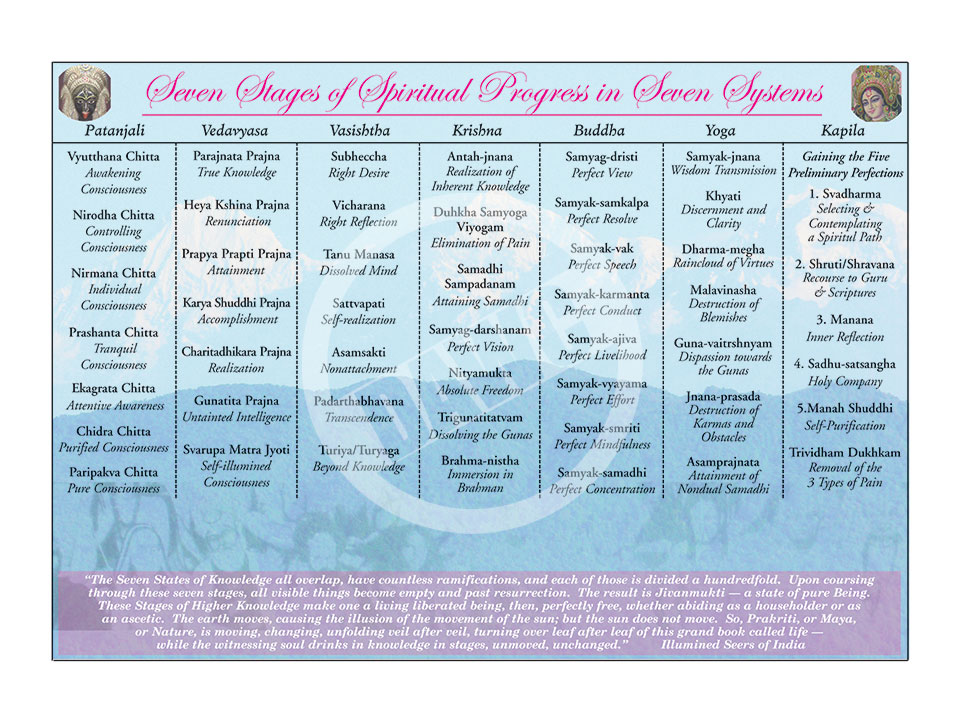
7 Stages of Spiritual Progress in 7 Systems #151
$75.00
The recurring philosophical phenomena of 7-fold systems of knowledge in India makes for an interesting study for the avid spiritual aspirant. In this dharma art wisdom chart these helpful looks at gradated wisdom are placed side by side for easy study and comparison, offering up clues for the deeper understanding of stages of progress along the spiritual path.
Related products

Lord Brahma’s Universal Projection #83
The dharmic teachings coming from ancient Vedic times are replete with wisdom concerning both God with Form, and God beyond form — what was termed Saguna Brahman and Nirguna Brahman in those times. Importantly, the connections between the two, i.e., God with attributes and God beyond attributes, proved the whole point of Absolute Existence to the ancients, described then as a single state of Consciousness that possessed the ability to bifurcate into two, then express Itself through the many — all without ever separating Its Essence in any way. Thus, when even gods and illumined souls take births in the outer realm with humankind, the intrinsic oneness of all paths and peoples gets well acknowledged under the auspice of Lord Brahma.

The Stainless Cause of the Universe #74
India’s cosmology is ancient and thorough in its depth and its scope. It is also eternal, since it sites principles that the Divine Being, in all its many aspects, utilizes to project, sustain, and dissolve the many realms of name and form that exist in time and space. Though the Divine Being is beyond causality, is the Causeless Cause, Its amazing Mind, the Mahat, or Hiranyagarbha, facilitates the appearance of countless worlds peopled by an infinite amount of living beings, all under the auspice of the Mahashakti, the Divine Feminine Power. Coming to know of this trickle-down process, from the highest and deepest Escalon on out to the gross, physical plane of existence, the soul very soon reaches for and attains the highest Wisdom that solves all problems, settles all issues, and even puts death to death.

India’s “Mind Only School” Perspective #176
One of the principles that India figured out a long, long time ago has been overlooked by the other religions of the world, that being that all and everything in the worlds of name and form has come out of the mind, at cosmic, collective, and individual levels. This has happened via the mind’s inscrutable power of projection. In this wisdom chart, the seeds that are present in the mind are seen to be stored at gradated levels inside of huge repositories of condensed thought-power. A mature ideology such as this far outstrips those theories proposed by Scientific Evolution, as well as Theology’s 7-Day creation theory.

The Three Eternal Gateways #132
As Vedanta, in its qualified form, states: All beings will be saved; all will see God. That is because the souls of all beings are Eternal, that is, the one Soul in all, called Atman, is perfect and indivisible, even when it seems to take many forms. In the taking of these forms, beings pass in and out of the embodied condition through channels, nadis, or gateways, as it were. This is a strictly inward process and has nothing to do with outer space. This dharma chart puts this cosmic process in terms of those who follow Truth dur ing their lifetimes, those who abandon Truth, and those who have realized their ever-perfect nature and embody to teach it to others. Two sets of four doorways are also illustrated here, so as to inform aspiring souls of the reasons for and mediums utilized via people’s choices and decisions in the rebirth process.