Back to Sankhya Yoga & Indian Cosmology
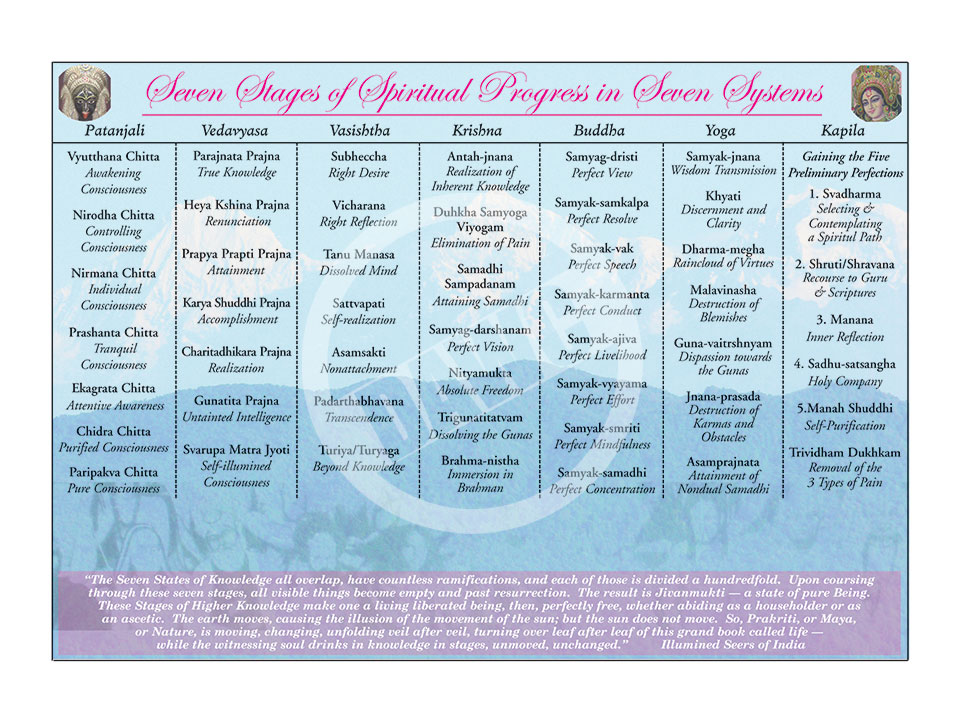
7 Stages of Spiritual Progress in 7 Systems #151
$75.00
The recurring philosophical phenomena of 7-fold systems of knowledge in India makes for an interesting study for the avid spiritual aspirant. In this dharma art wisdom chart these helpful looks at gradated wisdom are placed side by side for easy study and comparison, offering up clues for the deeper understanding of stages of progress along the spiritual path.
Related products

The Three Eternal Gateways #132
As Vedanta, in its qualified form, states: All beings will be saved; all will see God. That is because the souls of all beings are Eternal, that is, the one Soul in all, called Atman, is perfect and indivisible, even when it seems to take many forms. In the taking of these forms, beings pass in and out of the embodied condition through channels, nadis, or gateways, as it were. This is a strictly inward process and has nothing to do with outer space. This dharma chart puts this cosmic process in terms of those who follow Truth dur ing their lifetimes, those who abandon Truth, and those who have realized their ever-perfect nature and embody to teach it to others. Two sets of four doorways are also illustrated here, so as to inform aspiring souls of the reasons for and mediums utilized via people’s choices and decisions in the rebirth process.

6 Proofs of the Purusha #213
The Purusha, the all-intelligent, self-luminous eternal principle, is master over all of nature, called Prakriti. At least that is the way it should be. If the insentient material principle is taken to be the source of all instead, then the Purusha falls from its rightful status, and bondage occurs, along with suffering. To keep this from happening, the dharma teachings in Sankhya Yoga are transmitted in order to show the soul its own innate divinity, using six undeniable proofs that are both exceedingly powerful and deeply convincing.

Akasha — The Five Atmospheres #79
Similar in content and consideration to the principle of time, the principle of space gets treated in a unique way in Indian Cosmology as well. To say the word “akasha” within hearing of India and its religious and philosophical circles is to become swiftly informed as to the various levels of ether that exist within the human mind and soul. Knowing about an ether for every cross-section of living beings, in addition to their
corresponding realms or worlds, i.e., akashas, releases the embodied soul from the limited thinking that the physical universe alone exists, thereby directing it to the “Kingdoms of Heaven within.” In India, to study the subject of space is to find all the hiding places where the transmigrating soul sports, or hides, allowing for the revelation of the timeless, deathless Soul that underlies all such activity.

32 Points of the Immortal Dharma #165
In the Bhagavad Gita, Sri Krishna transmits a wave of dharmic qualities into the eager ears and open heart of Arjuna, informing him in no uncertain terms of what is to be most coveted in this life. Titled the Thirty-two Points of the Immortal Dharma in this wisdom chart, the list covers the full gamut of diverse attainments possible to aspiring mankind. With the Holy Trinity as the backdrop, this dharma art wisdom chart will grace any dwelling and illuminate all atmospheres, revealing all the divine attributes worth seeking along the spiritual pathway.